

Events to your SIEM
Latet Enterprise forwards server events and administration-log entries to your security systems. Start with Reports and administration log for counting, people, roles and license conditions. SIEM needs the siem feature; it does not grant access to Reports or Audit, which require reports.
Configure outputs
Section titled “Configure outputs”The Security role configures and tests outputs on Events to your SIEM; the Auditor role reads them. Dashboard access needs roles. Company-wide changes and tests require the company-account session when company_changes: sso. Readers see destination origins, not secret-bearing paths, queries or headers. A conflicting save returns 409 and reloads current settings; review them before trying again.
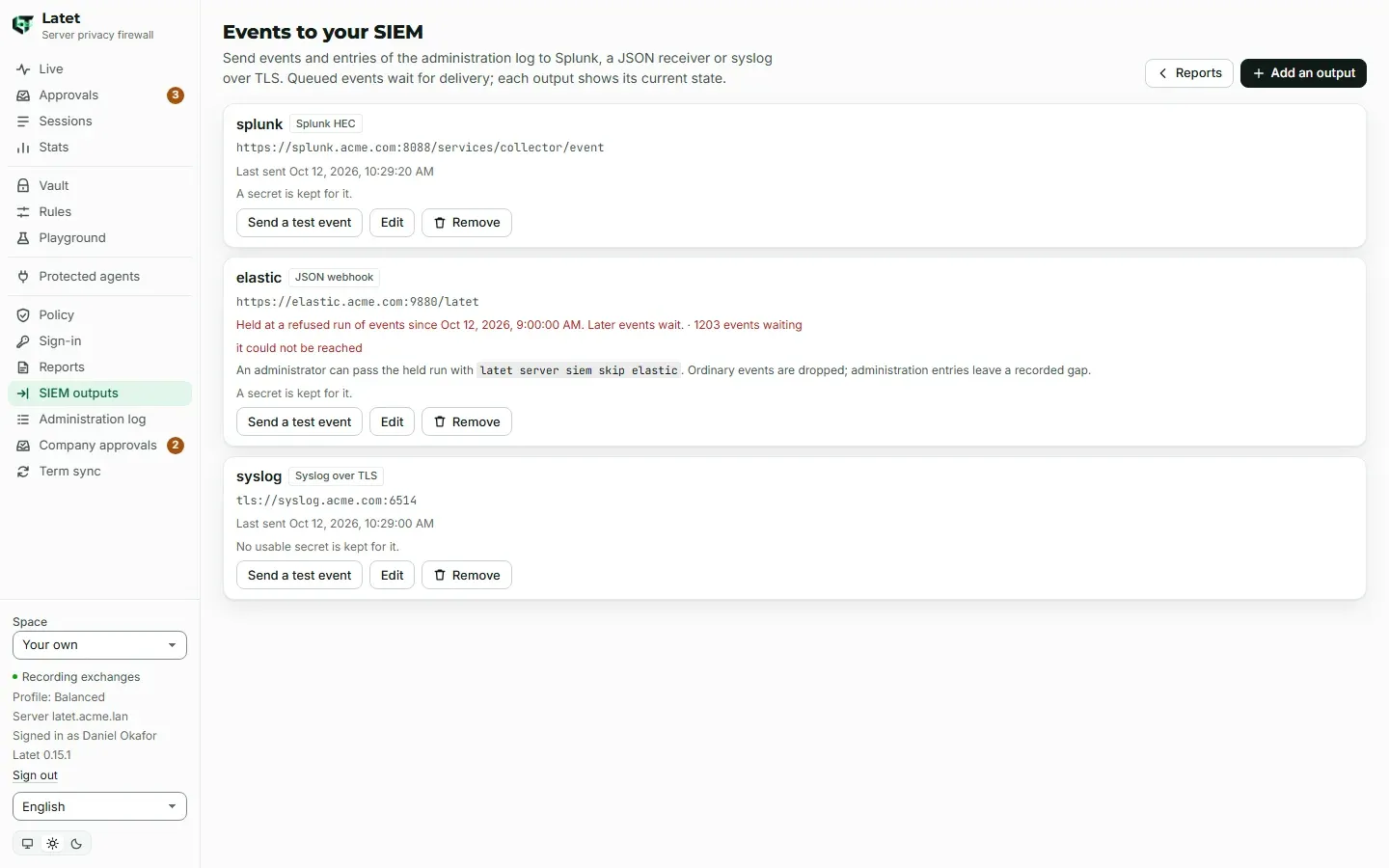
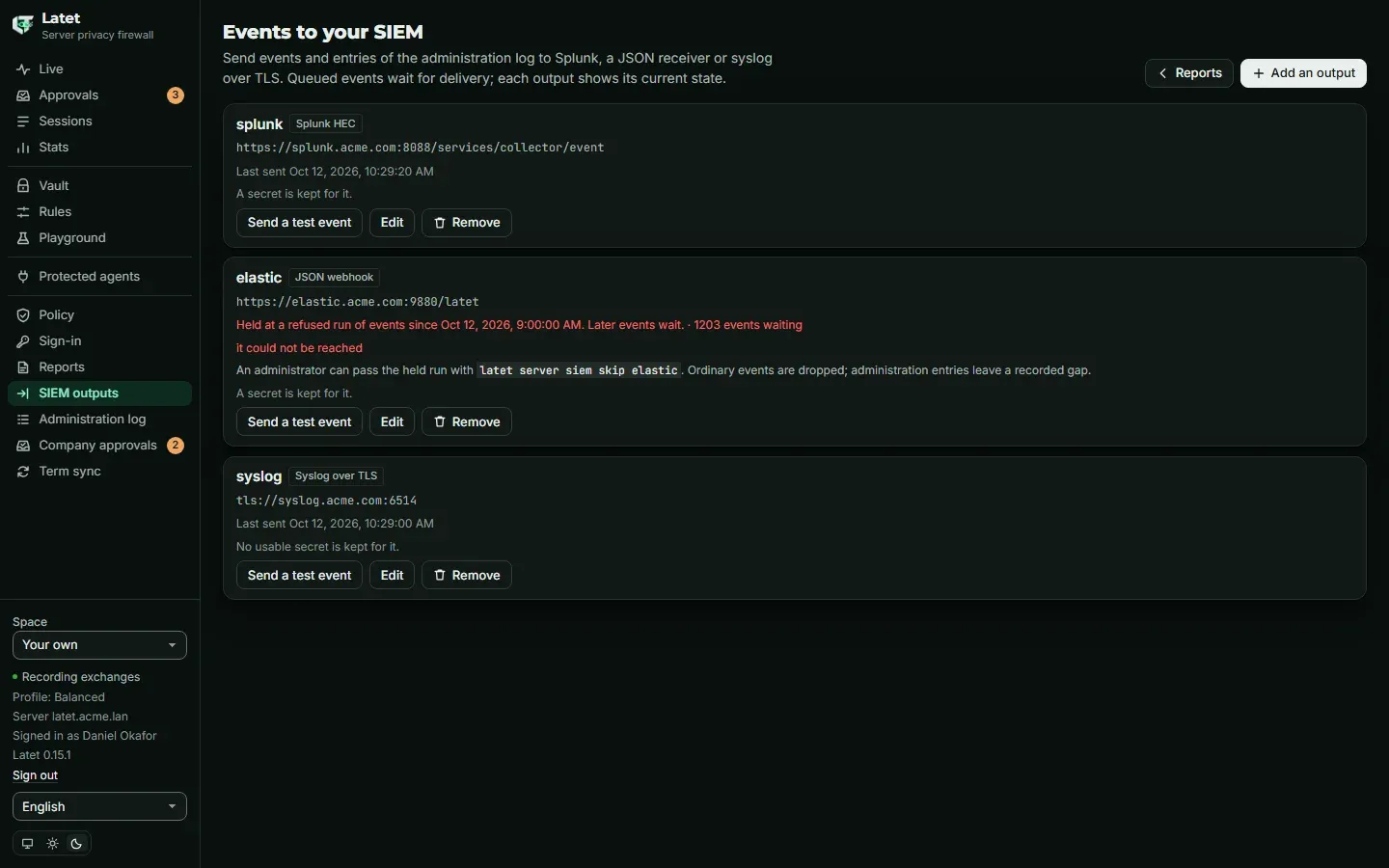
Up to 50 outputs are supported. Names contain lowercase letters, digits and hyphens, at most 40 characters. An existing name cannot be edited: renaming removes the old output and adds another, with the removal’s queue and secret consequences below. The administration-token CLI also configures outputs:
# outputs.yaml: latet server siem set outputs.yaml- name: splunk kind: splunk url: https://splunk.acme.com:8088/services/collector/event secret: siem-splunk- name: collector kind: webhook url: https://collector.acme.com/latet headers: Authorization: "Bearer {secret}" secret: siem-collector format: ndjson- name: syslog kind: syslog url: tls://siem.acme.com:6514latet server siem set outputs.yaml accepts a YAML/JSON list or a siem: [...] wrapper, at most 64 KiB both before and after JSON encoding. Aliases, non-JSON values/keys, excessive nesting and oversized structures are refused. It replaces the output list: preserve outputs you intend to keep. latet server siem show reads configuration/status; latet server siem secret splunk asks for the secret with hidden input, with no secret-value flag.
| Kind | Wire format |
|---|---|
webhook |
HTTPS POST, a JSON array (json) or one event per line (ndjson), with configured headers |
splunk |
HTTP Event Collector envelopes, sourcetype: latet:event, server hostname as host |
syslog |
RFC 5424 messages over RFC 5425 TLS, facility 13, hostname and event JSON |
Use a receiver or intermediary that accepts these formats and manages its downstream authentication. Direct Google SecOps webhook feeds and Azure Logs Ingestion are unsupported by this implementation’s address/credential rules. A successful HTTP transport test does not establish downstream indexing.
Secrets and destination binding
Section titled “Secrets and destination binding”Each output uses only siem-<output-name>. Its secret is sealed in PostgreSQL under the server’s master key; the dashboard accepts it once and never displays it again. Instances periodically rebuild outputs and reread secrets (normally every 60 seconds).
- Write
{secret}where a credential belongs in a path, query value or header, never in a hostname/port. URL insertion percent-encodes the secret. Secret/header inputs use visible ASCII. - Credential-like query/header names require the placeholder. Decoded path segments and query names/values are checked for embedded token shapes: long mixed-case or lowercase alphanumeric strings, 32-or-more hex digits and GUIDs. Encoding or embedding the token does not exempt it. Narrow exceptions are the workflow ID after
/workflows/on*.logic.azure.com, and one exactly spelledchannelquery parameter with a GUID on asplunkoutput. - Binding covers output name, kind, normalized destination, path/query and secret-carrying header names/values. Host case, trailing dots, default ports and harmless header case/order normalize; these spelling changes alone do not break binding. Changing the bound destination or a secret-carrying header requires setting the secret again before it can be sent there.
- Removing an output removes its secret. A rename does not transfer it. A missing or differently bound secret holds delivery with an explanatory status.
- Webhooks with a secret add
x-latet-signature: sha256=…, an HMAC-SHA256 over the body. There is no signature timestamp: receivers must deduplicate and reject replays using event IDs. - Headers such as
Host,Content-Length, forwarding headers,Cookie,Origin, proxy/browser-controlled headers andx-latet-*are refused. Limits are 32 unique case-insensitive header names, 64 characters per name and 4,096 per value. URLs are visible ASCII without spaces, at most 2,048 characters, with no user/password or fragment; use anxn--hostname for international names. Syslog accepts no query or meaningful path.
Where outputs connect
Section titled “Where outputs connect”The server checks the destination on saving and checks resolved addresses again at each connection, pinning the connection to a checked address: the first that takes it, the next only when the connection to the one before is refused or not made in time, before anything of a batch is sent. Company-private networks are allowed. Link-local (including cloud metadata), reserved, unspecified and multicast addresses, IPv6 forms carrying IPv4, and IPv6 zones are refused. DNS names cannot bypass this. IPv4 must use canonical dotted decimal; hostnames containing underscores are refused, so use a valid service alias.
Only explicit localhost, 127.0.0.1 or [::1] may name the server itself; HTTP is allowed only there. Over HTTPS or TLS, localhost works as 127.0.0.1 does, since the receiver’s certificate is checked at every address; over HTTP, write the address the receiver listens on (127.0.0.1 or [::1]), never localhost: localhost is tried at ::1 first, and any program on the server that listens there would be sent the events and the output’s secret. Local outputs, even HTTPS/TLS ones, can be edited and tested only through the CLI, not the dashboard. So is their secret: latet server siem secret sets it. In the dashboard they remain visible and removable. Examples for an administrator to run:
latet server siem test sysloglatet server siem showlatet server statusTests are limited to one per output per 10 seconds, 30 per output per hour and 30 per dashboard person or administration token per hour. Dashboard additions or moves to a different scheme/host/port allow ten destinations per person per hour, then 429. Refused saves and 409 retries can consume that allowance. CLI output saves have no such destination allowance. Every save/test is audited.
Environment proxies such as HTTPS_PROXY are ignored. TLS checks the destination name against the server’s certificate trust store; install your private CA there when needed. On Windows/macOS, the OS truststore may fetch certificate AIA URLs outside these egress checks. Each send has a 20-second deadline. Uncompressed response bodies are bounded to 64 KiB; compressed bodies are neither read nor inflated, but HTTP 2xx still counts as transport acceptance. Syslog’s TLS close_notify can wait up to two seconds within the send deadline.
Delivery and held batches
Section titled “Delivery and held batches”Requests do not wait for SIEM delivery. Each output has a PostgreSQL queue; instances lease it in turn and send ordered batches of up to 500. A lease expires in 60 seconds, which is not a takeover or delivery SLA: output turns are serial and a ten-second round budget is checked between turns.
HTTP 2xx means transport acceptance, not indexed delivery or Splunk indexer acknowledgment. Syslog has no application acknowledgment. Delivery uses at-least-once retries where events remain queued: an acknowledgment lost after acceptance, a crash or an expired lease can produce duplicates. Deduplicate by id; a forwarded administration entry has a stable ID. Retention, queue bounds and deliberate skips prevent a universal lossless or exactly-once guarantee.
- Network failures, redirects (never followed), HTTP 401, 403, 404, 405, 408, 409, 410, 411, 415, 425, 429 and 5xx retain/retry the batch after 5, 10, 30, 60, then 300 seconds.
- Other receiver refusals split the batch to isolate refused events. In a mixed result, individually refused non-admin events can be dropped and counted; an administration entry is held.
- A run entirely refused stays held and backed off, including an event-only run with
held: trueandblocked: false. A later network failure clears the refusal hold until another receiver attempt. Investigate the receiver’s logs before skipping. - Only the administration-token CLI can release a held run:
latet server siem skip <output>. Active leases/state checks can refuse it; expiry alone does not guarantee success a minute later. A skip includes rows committed late inside that held span. For event-only skips,from/toare null, administrationcountis 0 anddroppedcan be positive; no event-only gap marker is made. Administration ranges are attested as described below. - When an output’s total queue exceeds 200,000 events, trimming drops oldest
appsfirst, then other ordinary events. It never trims administration entries, so the total can remain above that threshold. The per-instance pipeline holds at most 10,000 waiting events, withappsat most half; database, shutdown and schema failures can lose events before counts are stored.
Send a test event sends a test event outside the event log. It reports the transport result, not proof that an index contains it. The dashboard, CLI and status show last success, failure/since, queued/dropped/collapsed counts, held state and secret problems.
Gaps and verification
Section titled “Gaps and verification”Administration forwarding starts once SIEM is licensed, near the retained last hour, not at the beginning of all history. siem.forwarding records its start. The authenticated forwarder note records progress. An unreadable note stops forwarding; deleting it while the retained start record exists also stops it. Restoring an older authentic note can resend entries, re-mark real gaps and later forward entries from a formerly paused period. Once retention removes siem.forwarding, deletion can look like an initial run again. Preserve external copies and retained chain anchors.
The SIEM copy can have these administration gaps:
- No output or no SIEM production: forwarding notes the unsent range. Its marker accompanies the next forwarded administration entry; resumption itself normally makes an entry. Previously queued events can resume delivery. This is not a promise that paused entries can never be replayed.
- Output removal: once an instance observes removal, that copy ends without a closing marker. A stale instance may send another batch. The queue and secret are removed; status counts abandoned administration entries. Other outputs receive the removal action.
- Long backlog: above 1,000,000 waiting administration entries per output, the oldest collapse into an attested marker down to 990,000. This is not a strict disk cap. Rough estimates are 400 MB per output and 20 GB for 50 such backlogs. Status warns at 100,000; a collapse causes FAIL until the next successful delivery.
- Administrative skip: skipped administration ranges gain a marker and a chained
siem.skippedattestation. Skipping a refused marker itself removes it from the receiver’s copy;siem.skippedretains its range on the server.
A range marker has type: admin, outcome: siem.gap, reason: audit:<first>-<last>, integer stopped equal to its entry count, null identity/target, and chain.prev from the first entry with chain.hash from the last. It carries no entry details. Marker and chained siem.gap/siem.skipped attestation commit together. A marker alone proves nothing; a matching authenticated retained entry must attest its range. It proves nonsending, not the cause: correlate license/settings entries. The log’s own siem.gap event has its own chain position and reason: server, not audit:….
latet server log verifylatet server log verify --siem siem-export.ndjsonVerification walks the keyed server chain, reports its head, and checks queued markers. With --siem, it also inspects every extracted outcome: siem.gap object, even a malformed event envelope. It accepts a regular, non-link file up to 256 MiB: event JSON arrays or NDJSON, HEC envelopes, Splunk result._raw exports and Elastic hits’ _source. A file with no recognized Latet event is refused.
Retained attestations are checked before age. Only old ranges without a retained attestation are reported unchecked after their entries pass retention; these old ranges alone do not cause failure. A broken or unwalkable chain, malformed/unattested current marker, or missing/malformed server verification information fails with exit 1; Community --siem, unreadable input and no-event files exit 2. Malformed marker/server responses never become a pass.
--siem checks markers, not completeness or authenticity of every ordinary exported event. A database writer can still suppress delivery or copy chain fields into a forged ordinary event. The server chain and external retained anchors remain necessary evidence. At a worst measured backlog, verification can retain a read-only snapshot for roughly 1.5 minutes, delaying vacuum; it can fail closed on timeouts rather than certify an incomplete scan.
Event fields
Section titled “Event fields”| Field | Meaning |
|---|---|
v |
Schema version, 1 |
id |
Event identifier, 32 hexadecimal digits; deduplication key |
ts |
Event time in UTC |
type |
Current producers: exchange, stopped, apps, policy, approval, change, sign-in, sync, license, admin; test is sent only by tests |
identity |
Person as the people setting keeps them, or API-key ID; admin actor follows the administration policy |
kind |
person, key, or null, including system/marker events |
group |
First person group at recording time, or null |
agent |
Agent code such as claude-code, codex, opencode, apps, or null |
project |
Folder name, at most 200 printable characters without path separators, or null; overflow is other; masked- and 8 characters when its name holds a masked term (reports) |
masked |
Counts by normalized type, such as EMAIL or CLIENT_NAME |
stopped |
Stopped request count; unanswered texts for apps; 1 for an approval not approved (rejected, abandoned, expired); represented entry count for gap markers |
reason |
Stop/license code; where a change came from; why a sync failed; non-person admin actor; or a marker’s audit:<first>-<last>; otherwise null |
outcome |
Operation/result code: scan/mask, policy/license outcome, how an approval or a change ended, how a sync ended (ok, failed, removed), admin action or siem.gap; otherwise null |
by |
Who decided an approval or a change when it was not the person (central approvals), or the person who asked for a sync or removed synced terms (term sync), kept as the people setting keeps a person; otherwise null |
rule |
Rule/setting ID, apps caller’s t_… token ID (never its value), a sync’s source as term-sync:<name> (term-sync alone for a removal that names no source), or admin target under the privacy policy; otherwise null |
chain |
Admin prev/hash, 64 hex digits each (prev empty at the chain’s start); marker endpoints as above; otherwise null |
Metrics and checks
Section titled “Metrics and checks”The server’s metrics listener exposes /_latet/metrics; see server operations. SIEM labels group by output kind, not name.
| Metric | Meaning |
|---|---|
latet_events_kept_total{type} |
Events counted by this instance |
latet_events_lost_total |
Events lost before counting, including queue pressure, database/shutdown loss and schema refusals |
latet_events_other_project_total |
Events subsequently counted after this instance’s per-identity hourly guard remapped their project to other; excludes database-only group/global overflow and mere use of the literal name other |
latet_siem_queued{kind} |
Shared database queue estimate refreshed every 30 seconds; use max across instances, not their sum |
latet_siem_sent_total{kind} |
Events transport-accepted from this instance |
latet_siem_failed_total{kind} |
Failed batches to retry |
latet_siem_dropped_total{kind} |
Ordinary events dropped through refusals or queue trimming |
latet_approvals_company_waiting{kind, route} |
Changes (change) and texts (batch) waiting for the security team (security) or an API key’s controllers (controllers); each instance reads it from the database every 30 seconds and says the same: take the largest. Central approvals |
latet_approvals_company_decided_total{kind, state} |
What stopped waiting through this instance, by how it ended (approved, rejected, withdrawn, stale, superseded, expired, abandoned, gone; and approved-unapplied and approved-changed, counted again among the approved, for an approval the person’s settings did not take and a text approved and then not sent): add the instances up |
latet_terms_masked |
Synced terms this instance masks now; missing until its terms first loaded (Term sync) |
latet_terms_behind_seconds |
Seconds this instance has masked older synced terms than the server holds (0: none); alert above 60 |
latet_terms_kept{state} |
Synced terms kept, still in their source (in-source) or no longer (gone); each instance reads it from the database every 30 seconds and says the same: take the largest |
latet_terms_unreadable |
Synced terms this instance cannot open (another master key sealed them); alert above 0 |
latet_terms_sources{kind, state} |
Term sync’s sources by kind and how their last sync went (ok, failed, never); read from the database every 30 seconds: take the largest |
latet_terms_runs_total{kind, outcome} |
Syncs run on this instance, by how they ended (ok, or the code of why they failed): add the instances up |
latet server status reports Event log settings/production and abandoned administration entries, plus each output’s delivery, failures, held run and secret state. The skip hint applies to held ordinary runs as well as blocked administration entries. A displayed siem.gap audit row is a record, not a cryptographic verification result.
Automated tests use local/fake webhook, HEC and TLS syslog receivers, failures and multi-instance scenarios. One healthy-acknowledgment multi-instance scenario checks single ordered arrival; it is not a guarantee after lost acknowledgments, crashes or lease expiry. No real Splunk deployment or manual indexing trial is claimed.
© 2026 Emanuele Casabona · VAT IT02293040990 · Privacy policy · Legal notice · latet.ai